- In 24 days
- 35 speakers announced
AICD Summit 2026
Tunis, Tunisia · In person · 2 days
5–6 December 2026
Saturday to Sunday
24 days to go
Royal ASBU Hotel
Avenue Cheikh Mohamed Fadhel Ben Achour, Centre Urbain Nord, 1003 Tunis
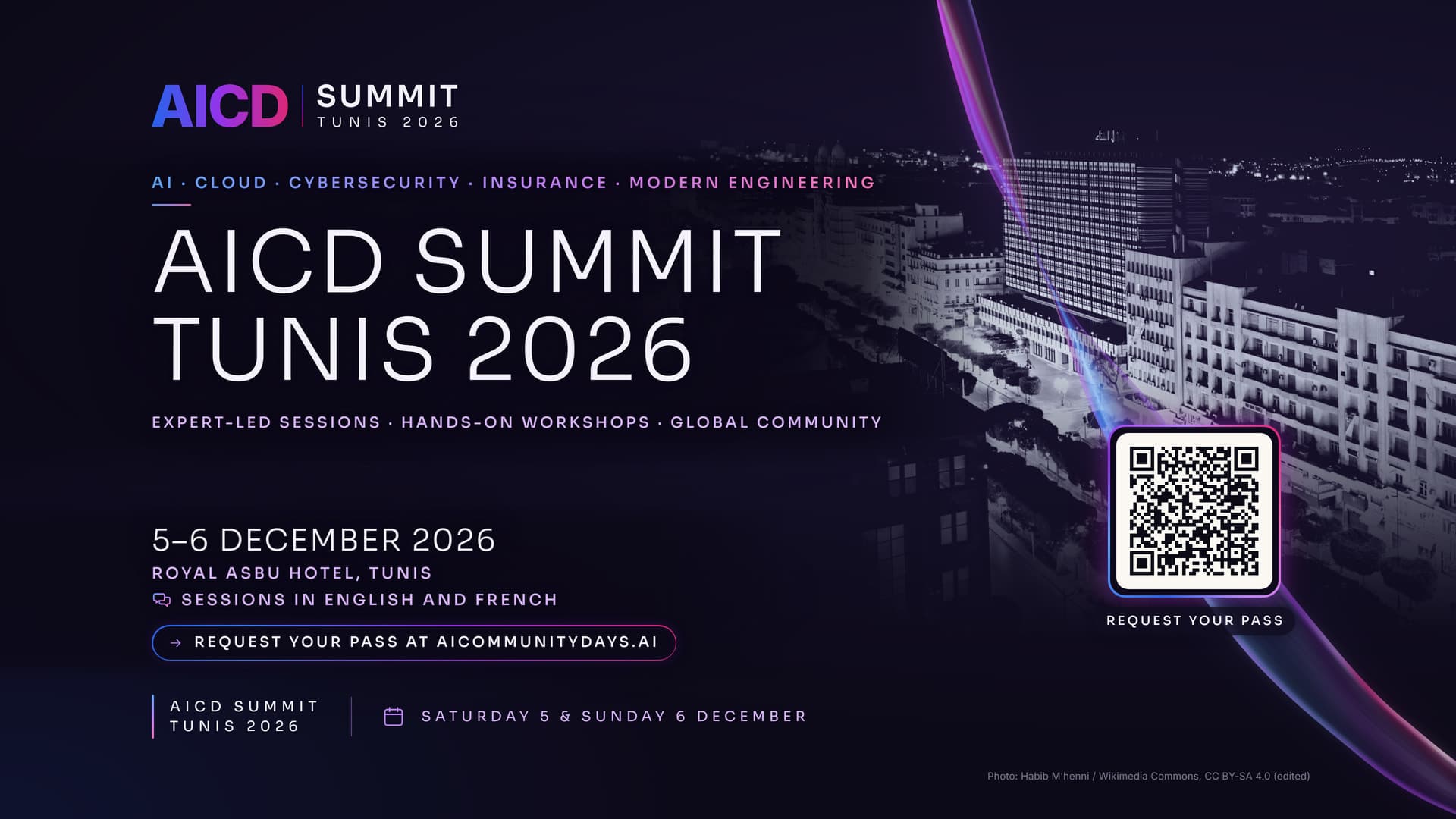
Tunis, Tunisia · In person · 2 days
5–6 December 2026
Saturday to Sunday
24 days to go
Royal ASBU Hotel
Avenue Cheikh Mohamed Fadhel Ben Achour, Centre Urbain Nord, 1003 Tunis
Passes
Pick the pass that suits you for AICD Summit 2026. Then pay online in one minute on the secure payment page of the bank, and we email you your confirmation. Requests close on 4 December 2026.
Price: 170 TND
Few tickets left
Both days, 5 and 6 December · All talks and hands-on workshops · Coffee breaks on both days. Student rate: a student card may be asked at the door.
To book a pack or a group, email us or message us on WhatsApp.
Cancellation: passes are not refundable. You can change the name on your pass for free until Thursday 3 December 2026.
Questions? Call or WhatsApp +33 6 21 21 50 24, or email [email protected] or [email protected].
Times in Tunis time (GMT+1)
When we talk about AI in leadership, the biggest mistake we can make is thinking it's just an efficiency tool to cut costs. AI isn't here to replace the leader; it is here to liberate the leader. Right now, too many executives are bogged down by operational noise—spreadsheets, scheduling, and standard reporting. AI absorbs that administrative burden. It acts as a supercharged co-pilot that instantly parses data, predicts market shifts, and flags risks. But here is the real magic: by taking over the cognitive heavy lifting of data processing, AI gives us back our most valuable asset—time. Time to focus on what data can never replicate: empathy, strategic vision, culture building, and truly connecting with our teams. AI handles the complexity so you can focus on humanity.
AI promised us a better world. Smarter Decisions, Real-Time Optimizations, Predicitive Capabilities and endless new business cases. Everything is supposed to be become better, faster and great. And then you actually try to make it happen. Suddenly it turns out that AI isn't the hard part, but everything else is. Legacy systems that refuse to cooperate, political trench warfare over ownership and prestige, a middle-management who don't trust "some algorithm" and an executive management that lacks basic understanding of AI while micromanaging every single aspect of it. This is the real-life inside story of introducing AI in a multi-million dollar project with a global manufacturer, a project I led from start to finish. Our goal was ambitious and the potential was huge, but reality had other plans. In this session I'll walk you through what actually happened from the unexpected resistance over the messy pivots to the moments that nearly killed the project. You will take home the insights you will need for your AI project to become a success. Because the biggest obstacle often is not technology or business cases. It is us humans.
.
AI systems are powerful, but they reason slowly and cost a lot, even when the task is only a simple decision. Should this request be approved? Which agent should handle this ticket? Does this answer need human review? Using a full LLM to answer these questions adds latency and cost. A decision model is built for exactly this job: it reads the input and returns a calibrated probability for each option, so your application knows when to act, when to escalate, and when to keep a human in the loop. In this hands-on session, we explore Microsoft-Decision-1, Microsoft’s new decision model, available in Microsoft Foundry. It follows JEV, the model that opened this category in September. What we will cover: -What decision models are, and how they differ from LLMs -Why every major AI company is now building decision models -The fast-moving evolution of decision models, from JEV (September 15) to Microsoft-Decision-1 today -What these new type of models change for AI engineer's: how we design, build, and pay for AI workflows? -Using Microsoft-Decision-1 inside a LangGraph workflow, with the graph and agents ready-made so you can focus on how decisions route through the edges -Monitoring and tracing the application with Microsoft Foundry
Everything in AI starts as sand. Within twelve months two research teams got through the silicon itself, and you can't patch silicon after it's printed. So how do you build an AI workload you can trust on a foundation you have to assume is cracked? This talk tells it as a castle. We start where every team starts: one engineer who put all the AI in a single VM. Then we build, one layer per chapter, and every layer is a real Azure control with its castle name: the bridge and the moat (Application Gateway and WAF), the windows with guards (NSGs), the door with a keeper (Azure Firewall), the gatekeeper who asks your name (Entra ID, RBAC, managed identity), the constitution read from the keep (Azure Policy and regulatory compliance), the night watch (Sentinel and Defender), and the well drawn only from inside (Key Vault, private endpoints, customer-managed keys). Then the falcon: the AI agent. In the Gulf, a falcon wears a hood; hooded, it sees everything and acts on nothing, and only the falconer's hand lets it fly. That is the whole of agent security in one picture. We follow an assassin who walks through every gate with a valid badge, and we watch the falcon's three failures from the OWASP LLM Top 10: the mirage (indirect prompt injection), the poisoned well (data poisoning) and the stolen leash (excessive agency), each with its fix. The proof is not a slide. I run a sovereign lab at home: eight AI agents, each in its own VM, no sudo, one list of doors each, and a night watchman that attacks them every night. The night before this talk it fired 95 attacks; 95 were refused, and the ledger that says so is on screen. You leave with three sentences: you can't patch silicon, so build like it's already cracked; the agent can't tell data from orders unless you make it; judge an AI by what it did, not by what it said. For architects, engineers and security leads building on Azure, and for the people who sign off on them. No prior AI security knowledge needed; Azure fluency helps but the castle carries you. Also available as a 20-minute keynote.
Most AI for tenders focuses on drafting the response. The expensive mistake happens earlier: answering a tender you could never win. In this session, I run a multi-agent war room live on a real, already-published public tender the system has never seen. The room votes first: go or no-go? Then the agents take over. - A requirements agent extracts every obligation from the tender, with its source page. Each one becomes a structured, calibrated decision (met / not met / disqualifying) made by Jev, a decision model that returns typed answers with probabilities instead of text. - Deterministic gates run before any probability: if a disqualifying clause can't be met, the answer is no, and anyone in the room can check it on the page. - The audience then adds a lever, such as a consortium with a certified partner, and the graph re-plans. - The bid is drafted and scored against the tender's own evaluation grid, turned into a Microsoft Foundry rubric. The final score comes from a held-out judge, from a different model family, that never guided the rewrites. The system cannot grade its own homework. Orchestration runs on LangGraph; agents interoperate with Microsoft Foundry through A2A. You will leave with four production patterns: deterministic gates before probabilistic ones, structured decision models inside the agent loop, held-out evaluation to avoid Goodhart's law, and framework-agnostic interop between LangGraph and Foundry. All data on stage is public or fictional. No customer data.
Deep dive on applying Zero Trust to secure MS Entra ID: latest updates, hybrid AD risks, "MS Entra ID Kill Chain" demo, ZTNA/Global Secure Access, and a step-by-step hardening plan. Description Zero Trust Principles in Enterprise: Where are we today and why accelerate adoption? Why and how to strengthen your MS Entra ID tenant starting tomorrow? Our 'step-by-step' approach" The benefits of adopting Zero Trust principles to secure the enterprise are numerous. For over 4 years now, the pandemic has led to an increase in cyber risk, prompting many companies to consider adopting it or adopting it faster than planned. In this presentation aimed at both security managers, architects, and IT managers, we will review the latest MS Entra ID Zero Trust updates and security issues related to hybrid AD & MS Entra environments. We will also discuss why it is essential to start strengthening your MS Entra tenant now, in addition to AD On-Premise. The session's themes will include: • Zero Trust Reminder: What is it, and where are we today with Microsoft? • Examples of several Zero Trust approaches • Focus on AD / MS Entra ID security issues • Introduction of the 'MS Entra ID Kill Chain' with Live Demo ✨ • Our approach to MS Entra ID Hardening 👌 in 'step-by-step' mode with ZTNA approach through Global Secure Access ( Internet and Private access ) the new era of Zero Trust ! • A soft and gradual action plan to complete the Zero Trust journey with a secure MS Entra ✨
L'IA tyrannique a complètement pris le contrôle du monde. Les humains ont été majoritairement exterminés ou réduits en esclavage, sauf pour un petit groupe de hackers de la Résistance. Tous les systèmes d'intelligence artificielle sont entre les mains d'un petit groupe élitiste mais omnipotent appelé L'Ordre Algorithmique, qui utilise une surveillance généralisée de type Big Brother, empêchant quiconque de communiquer librement ou simplement de se promener dans la rue. Nous sommes le dernier espoir de l'humanité. Nous devons pirater ou mourir. Ceci est une session démonstrative sur des menaces réelles, adaptée aux développeurs, ingénieurs de données, data scientists et consultants en sécurité. Tant les exploits que les recommandations de sécurité pour les éviter seront abordés. Avertissement: Aucun ZX Spectrum n'a été endommagé lors de la réalisation de cette session. (session en anglais)
Derrière chaque solution IA utilisée, déployée ou requête traitée se cache des dépenses humaines, indirectes, cachées, ... rarement comptabilisées. Cette intervention révèle les externalités silencieuses de l'IA et propose des pistes pour une facture plus transparente et responsable.
Governments worldwide are investing heavily in Artificial Intelligence to modernise public services, improve operational efficiency, and enhance citizen experiences. Yet many AI initiatives fail to deliver their expected outcomes, not because of technology limitations, but because organisations overlook the most critical factor in successful AI adoption: people. While discussions often focus on AI platforms, models, governance, and infrastructure, the real challenge lies in preparing employees, leaders, and stakeholders to work effectively alongside AI. Without the right skills, culture, trust, and change management strategy, even the most advanced AI programmes struggle to move beyond pilot projects. In this session, we will explore how government and public sector organisations can build an AI-ready workforce capable of embracing AI responsibly and confidently. Drawing on practical experiences from AI adoption, Microsoft Copilot enablement, workforce transformation programmes, and regulated industry engagements, attendees will learn what it takes to create sustainable organisational change in the age of AI. Key topics include: 1.Why workforce readiness is the biggest predictor of AI adoption success 2. Common barriers to AI adoption in government and regulated environments 3. Building AI literacy across technical and non-technical employees 4. Creating AI champions and change networks 5. Balancing innovation with governance, security, and compliance requirements 6. Developing trust, transparency, and responsible AI practices Measuring adoption, engagement, and business impact 7. Practical lessons learned from real-world AI transformation initiatives Attendees will leave with a practical framework for building an AI-ready workforce that can accelerate AI adoption while maintaining the trust, accountability, and public service values expected within government organisations. Whether you are a CIO, digital transformation leader, AI practitioner, policy maker, or public sector manager, this session will provide actionable insights and proven strategies to help your organisation move from AI experimentation to lasting organisational transformation
Tired of repetitive tasks? Want to streamline workflows and boost productivity? Join this hands-on workshop to learn how to automate processes effortlessly using Microsoft Power Automate! What You'll Learn: The basics of automation and Power Automate How to create flows to automate tasks across apps and services Connecting to Microsoft 365, SharePoint, Outlook, and more By the end of this session, you'll be ready to eliminate manual work, save time, and focus on what matters most, all with the power of automation
How can students and aspiring entrepreneurs use AI to turn an idea into a real business opportunity and then develop it? In this practical workshop, participants will explore how accessible AI tools can help them identify problems worth solving, understand customer needs, shape and test a business idea, and plan their first steps toward growth. Through guided examples and simple exercises, they will learn how to use AI for research, value proposition development, and business communication while keeping human judgment at the center. No technical background is required. Participants will leave with a clearer business idea and a practical, AI-assisted action plan. Suggested form selections Session type: Workshop Level: Beginner Audience: Students, aspiring entrepreneurs, early-stage founders, and people beginning to learn about AI Track: AI in Business / Digital Transformation Takeaways: Identify a business opportunity; use AI to explore customer needs and refine an idea; create practical next steps for launching or growing a business
This workshop explores how Artificial Intelligence (AI) is transforming the insurance industry by improving operational efficiency, enhancing customer experience, and supporting smarter decision-making. Participants will discover practical applications of AI in insurance, including claims processing automation, fraud detection, risk assessment, customer service chatbots, predictive analytics, and Generative AI. Through real-world use cases and practical demonstrations, the workshop will highlight how insurance companies can leverage AI to optimize their processes, reduce costs, improve risk management, and deliver personalized services. Key Topics: - AI applications in the insurance industry - Claims processing and workflow automation - Fraud detection and risk prediction - Generative AI and intelligent assistants - Customer experience and personalization - Challenges, ethics, data privacy, and responsible AI Target Audience: Insurance professionals, managers, data analysts, IT specialists, and anyone interested in AI-driven innovation in the insurance sector. Objective: To provide participants with a practical understanding of how AI can create value, drive innovation, and shape the future of insurance.
La plupart des organisations n’échouent pas à cause de leur stratégie, mais à cause de son exécution. Malgré les investissements dans la planification stratégique, les OKR et la gestion de la performance, les dirigeants manquent souvent de visibilité en temps réel sur l’avancement, les risques et les priorités. L’IA changent cette réalité en transformant la façon dont les organisations pilotent leur exécution. Cette session montre comment l’IA peut accélérer l’analyse stratégique, automatiser les insights de performance, détecter les risques d’exécution et soutenir la prise de décision. À travers des cas concrets, les participants découvriront comment relier efficacement objectifs, initiatives et résultats.
This session introduces participants to Microsoft Power BI and demonstrates how raw data can be transformed into meaningful insights and strategic decisions. Participants will explore data preparation, interactive dashboard creation, data visualization techniques, and real-time reporting through practical examples and hands-on demonstrations. The session also highlights how organizations use Business Intelligence to monitor performance, identify trends, and support data-driven decision-making.
Les données sont disponibles, les LLM sont puissants, mais les agents IA peinent souvent à comprendre le contexte métier de l'entreprise. Nous verrons comment Fabric IQ apporte la couche de sens nécessaire à l'IA grâce aux ontologies, au graphe métier et aux Data Agents. Une session orientée architecture et mise en œuvre, destinée aux architectes, data engineers et responsables data souhaitant passer de la donnée gouvernée à une intelligence gouvernée
Understand AI’s impact on entrepreneurship and business performance. Identify the new KPIs entrepreneurs must track in an AI-driven economy. Discover how AI can optimize costs, profitability, productivity, and decision-making. Develop a data-driven mindset to measure value creation and drive sustainable growth.
Discover how Generative AI is reshaping the risk and insurance landscape. Tailored for insurance executives, brokers, and operations leaders, this 4-hour session bridges the gap between daily productivity tools and enterprise-scale deployment. Participants will engage in hands-on sandboxes to automate underwriting data extraction and claims analysis, while exploring advanced strategic tools. Learn to establish critical compliance guardrails, mitigate data privacy risks, and build a high-ROI AI implementation roadmap for your organization.
AI is changing software engineering from writing code with an assistant to orchestrating agents that can plan, implement, test, and review software. But how do we make these workflows reliable, secure, and useful beyond a demo?
Everyone is rushing to implement AI… but very few organizations are truly ready. AI tools like Copilot promise productivity and insights but without the right data foundation, the reality is often: Users can’t find the right content Sensitive information is overshared AI returns inaccurate or outdated answers AI is only as good as the data behind it. In this session, I’ll share real-world experience from enterprise Microsoft 365 environments (SharePoint, Teams, OneDrive) and introduce how SharePoint Embedded is reshaping the way we design secure, scalable, and AI-ready content platforms. You’ll learn what “AI-ready data” looks like in practice: Designing a clear and scalable information architecture Fixing permissions and preventing oversharing Improving metadata, content quality, and versioning Applying governance (lifecycle, retention, ownership) Leveraging SharePoint Embedded to build application-driven, AI-ready storage and knowledge layers We’ll also cover a practical approach to: ✅ Assess your current data maturity ✅ Identify risks and quick wins ✅ Build a roadmap aligned with real AI use cases Whether you’re preparing for Copilot or building custom AI solutions, this session will help you transform your content into a trusted, structured knowledge layer ready for AI.
Building a GenAI prototype is easy. Keeping it reliable, safe, and cost-effective in production is where most teams struggle. That's where GenAIOps comes in: the practices and tools that bring discipline to how we deploy, monitor, and improve generative AI solutions. In this session, we'll break down what GenAIOps really means and how it builds on what you may already know from DevOps and MLOps, applied to the unique challenges of LLMs, prompts, and agents. Whether you're building your first GenAI app or scaling agents across your organization, you'll leave with a clear framework for taking AI solutions from "it works on my machine" to "it works for everyone, every day."
AI agents are changing how users interact with ERP systems, but how do you connect them safely to Business Central? In this session, we introduce the Model Context Protocol (MCP) and show how it lets AI agents read data, run actions and automate processes in Business Central. Through live demos, we’ll cover how MCP works with BC, how to expose and secure tools, real-world use cases (sales, finance, approvals), and best practices for partners and developers. You’ll leave with a clear roadmap to start building your own MCP-powered agents.
Explore the Microsoft IA solutions from generaative to agentic
AI agents are becoming key players in enterprise systems: analytical assistants, business copilots, autonomous decision workflows. However, autonomy brings new challenges in security, governance, and compliance. This session shows how Microsoft Foundry helps you govern, secure, and control agents across their entire lifecycle, using native data governance, access management, traceability, cataloging, and integration with the Microsoft security ecosystem. Through real-world use cases and architecture scenarios, you’ll learn how to: • Control agent access to sensitive data • Enforce consistent governance and security policies • Audit every AI interaction • Mitigate shadow AI
Most Copilot rollouts settle the technical questions first: licences, tenant configuration, data controls, which apps are enabled. Then the tool reaches someone’s desk and a different set of questions arrives, one task at a time. Is this client figure safe to paste in? Is this tool actually approved for this kind of work, or is it just what everyone uses? Did anyone in this meeting agree to being recorded and processed? Unanswered, those three questions become a tax on every single use. The professional pauses, hunts for a policy that may not exist in any findable form, messages a colleague who may not reply before the moment passes, and spends longer on the question than the task would have taken. Multiply that across a working year and it stops looking like caution and starts looking like friction nobody budgeted for. Settled once, the same three questions become a three-second check. This session walks through the three foundations that have to be fixed before a Copilot workflow is worth building: a data-tier rule plain enough to apply in seconds, a clear position on which tools are genuinely sanctioned for the work, and a standing consent norm for recorded conversations, including what to do when someone has not agreed. Each becomes a single go or no-go position rather than a judgement remade under pressure. The framing follows what governance bodies already argue. Both the NIST AI Risk Management Framework and the OECD AI Principles treat clear rules as something that accelerates adoption rather than restrains it, because a rule converts a vague worry into a fast, repeatable check. Governance here is not the brake. It is the steering. Attendees leave with a one-page foundation check they can complete for their own team the same week, and a clear view of which of the three is unsettled in their organisation right now. Key takeaways: 1. The three questions that must be settled before Copilot touches real work, and why leaving them open costs time on every use 2. A one-page go or no-go check covering data classification, tool status and recording consent 3. How to frame governance as something that speeds up adoption rather than constraining it 4. A practical way to find which foundation is unsettled in your own organisation
On June 1, 2026, GitHub Copilot moved from premium requests to token-based AI Credits, and the AI coding bill stopped being a flat subscription and became a production cost. Gartner now predicts AI coding costs will exceed a developer’s salary by 2028. Most teams have no idea what they pay per token, or where those tokens go. Claude Code, Codex and Copilot are different front doors to the same models and the same token prices. This session opens the meter: what an agent actually sends on every turn, why your message is the smallest part of the bill, how prompt caching works, and how one edited line can make the agent re-read everything at full price. Then, live: the same task run in Claude Code and Codex side by side, once the default way and once with discipline, with the real token bill on screen. You’ll leave with a playbook that works in any of the three tools: right-size the model and effort per task, keep your instructions file stable so it stays cached, give the agent only the context it needs, and start fresh between tasks. Plus how to put team-level budgets in place without killing adoption.
How do skills, APIs, and MCP work together in a practical AI agent? This demo-driven session explores these building blocks through a concrete B2B prospecting workflow. We will define a target customer profile, connect external data tools, and create a reusable skill that guides an agent through company discovery, qualification, and personalized outreach preparation. Using Codex for the main demonstration and Claude for a focused comparison, we will examine what changes across environments and what can be reused. We will also explain the roles of API authentication and MCP connections, with Treg and AIsa as integration examples. The live workflow will produce a shortlist of companies, evidence-backed qualification notes, and outreach drafts for human review. Along the way, we will inspect missing information, unsupported assumptions, and API usage costs. Attendees will leave with a clear understanding of how these components fit together and a practical method for designing and testing their own tool-connected agents.
This session breaks down how AI agents actually work under the hood, and how engineering teams can cut token costs while improving reliability: • Context windows explained: Compares an LLM's context window to computer RAM, showing why exceeding it causes hallucinations and lost history • Four context engineering strategies: writing, selecting, compressing, and isolating context to keep agents focused and efficient • Memory frameworks: working, semantic, procedural, and episodic memory, and how each plays a role in agent performance • Sub-agent architecture: splitting complex tasks across isolated agents for better accuracy, with real cost tradeoffs • Practical tooling: hands-on walkthroughs of /compact, /context, /clear, and the new /checkup command for auditing setups • Prompt caching tactics: how TTL differences between subscriptions and API access impact cost, and habits that silently break caching • Tiered model strategy: when to use high-capacity models for planning versus cheaper models for execution
The session will be about highlighting the importance of Governance, sustainability towards AI Agents exploitation for network managmenet,
Most enterprise AI initiatives don’t fail at the idea stage; they fail during implementation. In this session, I’ll share 5 key lessons from real-world AI adoption inside organizations, focusing on what happens after rollout. We’ll explore common breakdown points, including low user adoption, unclear data ownership, and AI tools that don’t align with daily workflows. I’ll walk through real scenarios where initial approaches didn’t work, the constraints we faced, and the adjustments that delivered measurable results. Attendees will leave with practical guidance on how to avoid common pitfalls, integrate AI effectively, and drive adoption across teams. This session is about decisions, trade-offs, and actionable strategies not theory/generic tool demos.
Picture two sales teams, two CRMs, and one enterprise account that shows up differently in both. Now multiply that across every region, every quarter, for the next three years. This is the reality for most companies mid-merger or mid-migration: sellers duplicating records across systems, operations teams unable to produce one trustworthy pipeline number, and nobody quite willing to say how long “temporary” coexistence has actually lasted, let alone whether the underlying data is clean enough to power anything resembling AI. Point-to-point integration makes this worse, not better. Every new connector must be tested against every existing one, and maintenance cost grows faster than the number of systems involved. Hub-and-spoke synchronization offers a different path: a centralized data exchange that normalizes entities once and publishes canonical events outward, so connector count scales linearly and integration health becomes something a team can actually see on one dashboard. This session builds the pattern piece by piece: event-driven bidirectional synchronization that propagates changes in seconds rather than overnight batches, canonical entity modeling with effective-dated rules so policy can change mid-year without rewriting history, and entitlement-aware federation that keeps downstream workflows honest about what a customer is actually entitled to. We also cover the less glamorous half of the story: reliability engineering for the hub itself, including chaos testing, reconciliation jobs, and the operational playbooks that keep teams informed instead of guessing during an incident. Attendees will leave able to judge whether their integration problem calls for a hub-and-spoke pattern, design canonical entities that survive a mid-year policy change, and build reliability practices for an integration hub the same way they would for a customer-facing product. Built for engineering teams currently living through, or about to start, a multi-year platform coexistence period that any future AI layer will depend on.
Enterprise transformation often stalls not on ambitious new platforms but on the unglamorous plumbing beneath them. In large payroll environments, inbound files arriving from dozens of internal and external sources are frequently handled through manual checks, ad hoc scheduling, and delayed error discovery, an approach that is costly, fragile, and difficult to audit. This session presents a production-proven automation architecture built for a multi-campus public university system’s PeopleSoft HCM environment, supporting a workforce of more than 200,000 employees. By combining GoAnywhere Managed File Transfer, Control-M scheduling, PeopleSoft Integration Broker, and integrated reporting, the framework now processes over 200 inbound files per pay cycle, spanning 11 file layouts from 15 different source locations, without manual intervention. Attendees will walk through the architecture end to end: how files are received and routed, how job orchestration is triggered and sequenced, and how processing outcomes feed real-time error and summary reporting. The session highlights the configurable design patterns that give users control over processing schedules, archival strategies, and exception-handling logic, so execution can be tailored to specific business needs. The discussion also covers lessons learned from running this framework at enterprise scale, including immediate file-level error detection, faster resolution turnaround, and stronger data integrity across payroll interfaces. The solution currently saves hundreds of person-hours each pay cycle and has improved processing accuracy to 100%. For architects and engineering leaders, the takeaway is a reusable pattern for building reliable, observable, and scalable data pipelines: the kind of trustworthy foundation that any analytics or AI initiative ultimately depends on.
Agentic AI is moving from demo to production in e-commerce, powering conversational search and recommendation systems that act on shopper intent in real time. As these agents gain autonomy, a trust gap opens. When users cannot see why a product was recommended or excluded, their confidence drops. Regulations such as the EU Digital Services Act are also making explainability a baseline requirement for responsible AI. This session presents an engineering framework for building explainability directly into agentic search. It is organized around five interdependent components. A Goal Engine disambiguates user intent, and a Perception Layer interprets and explains queries. A Decision Core exposes the reasoning behind recommendations and exclusions. A Memory Store makes personalization auditable, and a Feedback Loop connects explanations to business outcomes. The talk then covers what this takes in production. That includes interfaces with transparent preference controls and an explainability layer built on LIME, SHAP, and attention visualization. It also includes semantically aware backend ranking and privacy-preserving analytics, including federated learning, that measure impact without exposing user data. The session also examines what makes agents trustworthy at scale: autonomy that is honest about its limits, goal-directed behavior tied to visible motives, calibrated transparency, and natural-language interaction that can answer “why did you show me this?” Finally, the session makes the business and governance case. Explainability reduces purchase anxiety and strengthens loyalty. It cuts technical debt from opaque models and gives engineering teams the visibility to debug and optimize recommendation pipelines, while staying ahead of regulatory scrutiny. The session draws on hands-on experience delivering production AI search for enterprise retailers. It gives AI engineers, architects, and technology leaders a practical blueprint for agentic systems that are both capable and accountable.
Hackathons and launch workshops get a lot of developers to try an AI tool once. A few weeks later, most of them have gone back to what they used before. I run hands-on AI workshops roughly every week for partner launches around APIs, agent infrastructure and inference, and I see this pattern often. This session covers what moves people from a first demo to regular use: picking a first project people actually need, a working sample app they can extend, mentors who answer quickly in the first week, and feedback that goes back to the product team. It's for teams rolling out AI tools inside a company and for anyone running developer programmes. Key takeaways: - Why usage drops after launches and hackathons - What to give developers in the first week so they keep going - How to use feedback to fix what blocks people
The modern workplace is rapidly evolving from AI-powered assistants to agentic AI that can reason, collaborate, access enterprise knowledge, and take action. This session explores the latest Microsoft AI technologies—including Microsoft 365 Copilot, Copilot Studio, Microsoft Foundry, Agent 365, MCP, A2A, Work IQ, Fabric IQ, Computer Use, and multi-agent orchestration—and how they can transform everyday workplace processes. Attendees will explore practical enterprise architecture patterns for building secure, governed, and intelligent AI agents across Microsoft 365, Teams, SharePoint, Power Platform, Fabric, and enterprise systems. Real-world scenarios will demonstrate the journey from Copilot → AI Agent → Multi-Agent → Autonomous Business Process, along with key considerations for agent identity, security, governance, observability, RAG, enterprise data, and human-in-the-loop workflows. The session is designed for technology leaders, architects, developers, and Microsoft professionals looking to understand how to move beyond traditional Copilot implementations and build the next generation of AI-powered modern workplaces.
35 speakers announced so far.

I break down Azure security so you don’t break production
Speaking in Tunis · 5–6 Dec
Lead Software Engineer @ Maibornwolff Sàrl
Speaking in Tunis · 5–6 Dec
Human Being 🌈 🇵🇹 🇪🇺
Speaking in Tunis · 5–6 Dec
Senior Engineering Leader, GTM Integration & Provisioning at Cisco Systems Inc.
Speaking in Tunis · 5–6 Dec
Technical & Functional Consultant, Microsoft Dynamics 365 Business Central | ErpNextWave | ERP Growth Builder
Speaking in Tunis · 5–6 Dec
Applied Thought auditors & consultants inc
Speaking in Tunis · 5–6 Dec
Solutions Architect @ Bloomreach Inc. | Alumni of New Jersey Institute of Technology
Speaking in Tunis · 5–6 Dec
Head of Training Services & Cloud Solutions Expert
Speaking in Tunis · 5–6 Dec
Chahira Coaching et Consulting
Speaking in Tunis · 5–6 Dec
Microsoft MVP • DevOps & Cloud Architect
Speaking in Tunis · 5–6 Dec
Expert en Management de Projet et Excellence Managériale et Opérationnelle.
Speaking in Tunis · 5–6 Dec
Business Talk
Speaking in Tunis · 5–6 Dec
AI Automations & Agentic Solutions Architect | Digital Transformation Leader | Enterprise AI & Data Strategy | Power Platform & Fabric Architect | Program & Delivery Management | Cloud Modernization M
Speaking in Tunis · 5–6 Dec
Intellico - Président consultant senior
Speaking in Tunis · 5–6 Dec
PhD in Telecom, Senior Researcher at InnovCOM Lab, Sup'COM Tunisia
Speaking in Tunis · 5–6 Dec
Directrice bancaire, formatrice et consultante en finance, management et IA appliquée
Speaking in Tunis · 5–6 Dec
Senior Developer Advocate | Microsoft MVP Microsoft 365 & SharePoint | International Speaker | Community Leader | Product Evangelist
Speaking in Tunis · 5–6 Dec
AI Engineering Student | LangChain Enthusiast | Azure AI Foundry | Scout Leader
Speaking in Tunis · 5–6 Dec
Software Consultant | .NET & C# Specialist
Speaking in Tunis · 5–6 Dec
Dev Ecosystem Lead
Speaking in Tunis · 5–6 Dec
Technical & Functional Consultant – Microsoft Dynamics 365 Business Central
Speaking in Tunis · 5–6 Dec
Founder & Principal Consultant
Speaking in Tunis · 5–6 Dec
Comms Strategist, AI-Systems Consultant | Founder @ Système Gagnant
Speaking in Tunis · 5–6 Dec
Microsoft Copilot & Power Platform Specialist | DevRel | AI Enablement & Adoption | Agentic AI | Speaker | Creator
Speaking in Tunis · 5–6 Dec
AI Architect · Making enterprise AI actually work with agents
Speaking in Tunis · 5–6 Dec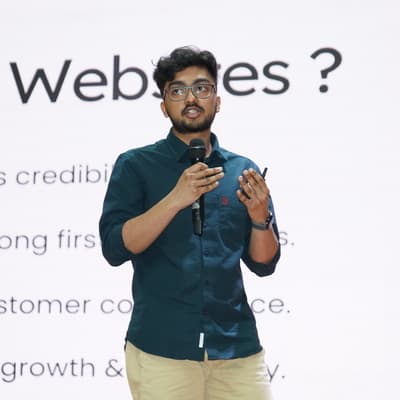
Software Engineer (Growth and AI) at rtCamp
Speaking in Tunis · 5–6 Dec
Quantum Technology Inc
Speaking in Tunis · 5–6 Dec
AI & Data Engineer, Trainer, and Consultant | AI & Data Engineer @TunkubeOps | Microsoft & Google Certified Professional
Speaking in Tunis · 5–6 Dec
Cloud Security Architect -Microsoft Regional Director & Microsoft MVP Security
Speaking in Tunis · 5–6 Dec
Microsoft, Solution Engineer Data Analytics & Governance
Speaking in Tunis · 5–6 Dec
Applied AI Educator | Author | Founder, Infinity AI
Speaking in Tunis · 5–6 Dec
AI Strategist | International Speaker | Founder, ArnavTech Consultants | Microsoft Copilot, Agentic AI & Workforce Transformation Advisor
Speaking in Tunis · 5–6 Dec
Founder of SimpliTraining and MCT Trainer
Speaking in Tunis · 5–6 Dec
Microsoft Certified Trainer | CHAFROUD.NET
Speaking in Tunis · 5–6 Dec
Doctor of Computer Science, Data science specialist, Teacher-Researcher at ESPRIT, member of the RIADI laboratory at ENSI.
Speaking in Tunis · 5–6 DecEvery AI Community Day is run by volunteers from its city, with help from the global team.
Organizers appear here as they confirm their place on the event.
Volunteer in TunisThe people who run AI Community Days around the world.
CEO & Founder

Global Coordinator
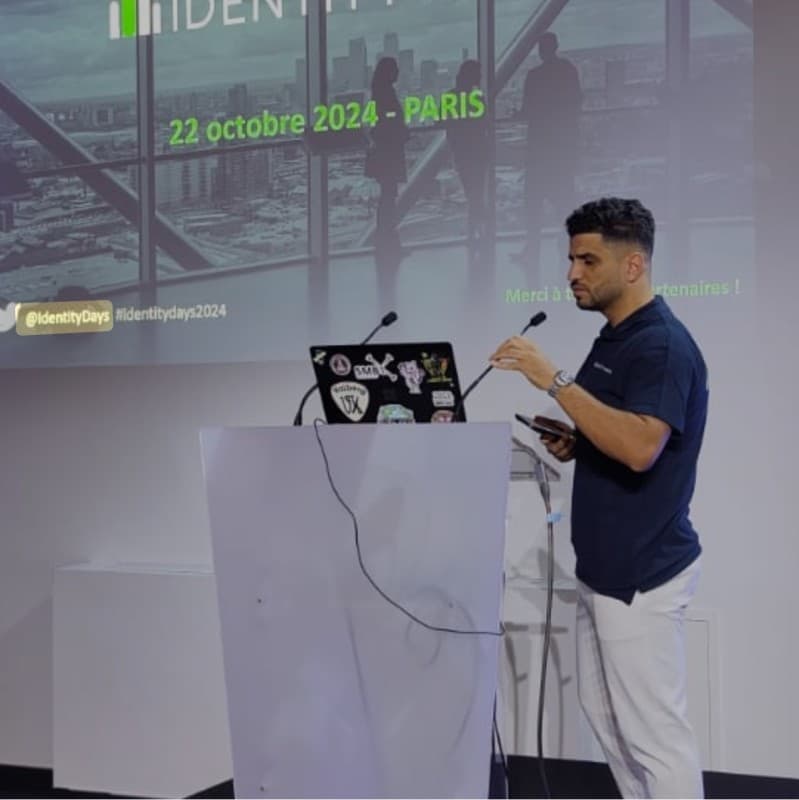
CEO · Cloud and Security Architect
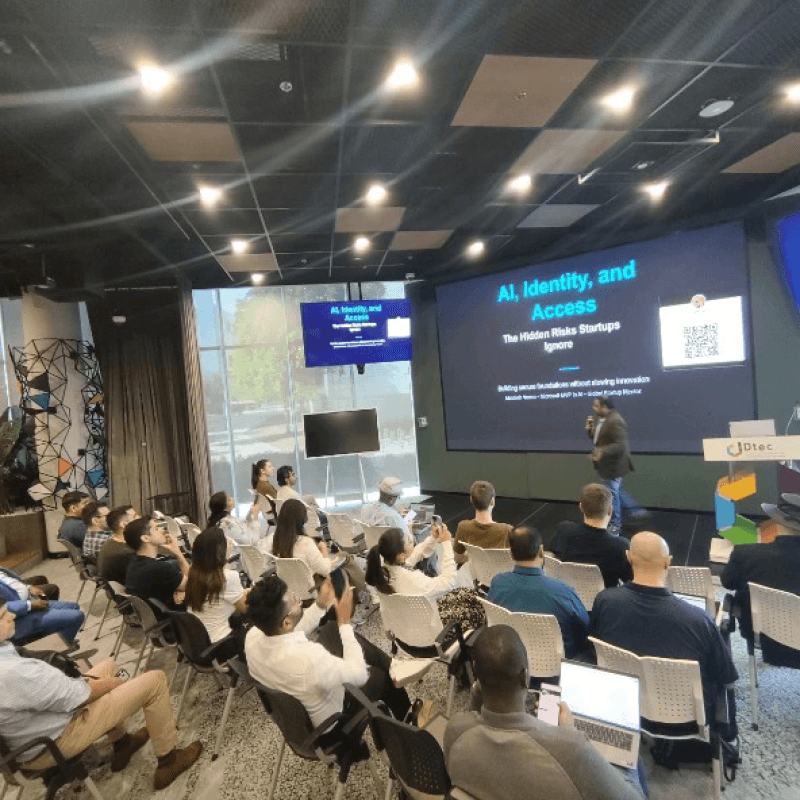
Global Coordinator

Cloud and AI Engineer · Tech Trainer · Tech HealthCare Expert · Women in Tech Advocate

Global Coordinator

Chief Information Security Officer at FORTEIA

AI, Microsoft 365 and Power Platform Architect · MCT and MVP · Trainer · Speaker

Founder & Independent Technical Consultant · Microsoft Certified Trainer (MCT) · Power Platform, M365, AI & Copilot

Microsoft Certified Trainer
AI & Data Science Consultant

Solution Architect on Microsoft Dynamics & AI

Global Organizer
Partners
We work with them at every AI Community Days event, in every city.








Be part of it
Every AI Community Day is run by volunteers from its city. Here is how you can help this one.
Put your brand in front of the people building with AI in Tunis. Packages from 1,500 TND, and a Startup Corner at 1,200 TND.
Help with check-in, rooms and social media, and meet everyone behind the scenes.